From Wikipedia, the free encyclopedia(Redirected from List of ongoing conflicts)Jump to: navigation, searchFor recent conflicts that are no longer significantly ongoing, see List of wars 2003–current.
Major wars - 1000+ deaths per year Other conflictsThe following is a list of ongoing political conflicts that are taking place around the world and which continue to result in violent deaths. This list is for the sole purpose of identifying present-day conflicts and the death toll associated with each conflict. Fatality figures include both civilian and military deaths. Political conflicts which no longer produce violent deaths are not listed here, but can be found in the historical list of wars and the list of wars extended by diplomatic irregularity.
Contents
[edit] 1000+ deaths per year
Conflicts in the following list are currently causing at least 1000 violent deaths per year, a categorization used by the Uppsala Conflict Data Program[1] and recognised by the United Nations[2][3]. The UN also use the term "low intensity conflict", which can overlap with the 1000 violent deaths per year categorization.[4]
Start of Conflict War/Conflict Location Cumulative fatalities 1967 Naxalite-Maoist insurgency India
10,500+ (1,100 in 2009)[5] 1978 Civil War in Afghanistan (5th Phase) Afghanistan
600,000-2,000,000 1991 Somali Civil War (5th Phase) Somalia
300,000[6] –400,000[7] 2003 Civil war in Iraq Iraq
~100,000-1,000,000 2004 War in North-West Pakistan Pakistan
30,452[8] 2006 Mexican Drug War Mexico
More than 28,000[9] 2009 Sudanese nomadic conflicts Sudan
~2,500 [edit] Other conflicts
There are many other smaller-scale armed conflicts that are currently causing a smaller number of violent fatalities each year.
[edit] See also
- List of wars (including historical wars)
- Modern warfare
- Declaration of war
- List of rebel groups
- List of terrorist incidents
Lists of wars by date [edit] References
- ^ "Definitions". http://www.pcr.uu.se/database/definitions_all.htm#inten. Retrieved 2009-05-04.
- ^ "The World at War". GlobalSecurity.org. http://www.globalsecurity.org/military/world/war/index.html. Retrieved 2008-05-12.
- ^ "Humanitarian Negotiations with Armed Groups, A Manual & Guidelines for Practitioners". http://ochaonline.un.org/humanitariannegotiations/Chapter1-2.htm#FNfour. Retrieved 2009-05-04.
- ^ "UN peacekeeping chief says Darfur `a low-intensity conflict' with 150 deaths a month". http://www.startribune.com/nation/43815017.html?elr=KArks:DCiUMEaPc:UiacyKUUr. Retrieved 2009-05-07.
- ^ "India's Maoists offer ceasefire". BBC News. 2010-02-22. http://news.bbc.co.uk/2/hi/south_asia/8529124.stm. Retrieved 2010-05-08.
- ^ Twentieth Century Atlas - Death Tolls and Casualty Statistics for Wars, Dictatorships and Genocides
- ^ Hundreds of thousands killed in years of war, says new president
- ^ http://www.vamban.com/global-war-on-terror-claims-30000-pakistani-casualties/
- ^ http://www.bbc.co.uk/news/world-latin-america-10860614
- ^ http://books.google.com/books?id=N3LfkrrNM4QC&pg=PA215&dq=arab-israeli+fatalities&hl=en#v=onepage&q=arab-israeli%20fatalities&f=false]
- ^ Estimate Israel casualties of war
- ^ http://www.ploughshares.ca/libraries/ACRText/ACR-Colombia.html#Deaths
- ^ http://www.peri.umass.edu/fileadmin/pdf/dpe/modern_conflicts/death_tolls.pdf
- ^ This is disputed as some roots of the conflict originate back in the early 1900's
- ^ Guide to the Philippines conflict BBC
- ^ The Mindanao Conflict in the Philippines: Roots, Costs, and Potential Peace Dividend
- ^ http://www.presstv.com/detail.aspx?id=132402§ionid=351020204
[edit] External links
- PeaceReporter coverage of ongoing wars
- Global Security coverage of ongoing wars
- BIPPI coverage of ongoing wars
- History Guy's coverage of 21st century wars
- Heidelberg Institute for International Conflict Research (HIIK)
- Conflict Barometer - Describes recent trends in conflict development, escalations, and settlements
- Insight on Conflict - Database on peace-building initiatives in areas of conflict
- Crisis Group conflict analysis
- Iraqi Death Total Over 600,000
Retrieved from "http://en.wikipedia.org/wiki/List_of_ongoing_political_conflicts"
Sunday, 12 September 2010
List of ongoing political conflicts - Wikipedia, the free encyclopedia


Naxalite-Maoist insurgency - Wikipedia, the free encyclopedia
From Wikipedia, the free encyclopedia
Jump to: navigation, search
It has been suggested that this article or section be merged with Naxalite. (Discuss)
Naxalite-Maoist insurgency
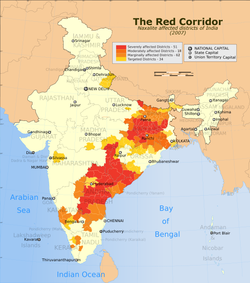
Map showing the districts where the Naxalite movement is active (2007)
Date 1967– present Location Red Corridor Result Conflict ongoing. Belligerents Commanders and leaders Gen. V K Singh, Chief of Army Staff
ACM P V Naik, Chief of the Air Staff
Vikram Srivastava, Dir. Gen. CRPF
Strength 1,414,000 1,800,000 in reserve [2]
10,000 to 20,000 and "hundreds of thousands" of supporters. (2010)[3][4][5] Casualties and losses Since 2002: 1,601 killed Since 2002: 1,686 killed 6,000+ killed overall[6] (1980-2000[7])
564 killed overall (2001)[8]
Since 2002: 4,193 civilians killed
Ranipotili – Balimela – Rajnandgaon – Green Hunt – Silda – Dantewada (1st) - Dantewada (2nd) - Narayanpur
North-East India - Naxalite-Maoist - Jammu and Kashmir
The Naxalite-Maoist insurgency is an ongoing conflict[9] between Maoist groups, known as Naxalites or Naxals, and the Indian government.[10]
The insurgency started as a peasant rebellion in the eastern Indian village of Naxalbari in 1967 and has currently spread to a large swath in the central and eastern parts of the country referred to as the "Red Corridor"[11]. In 2006 Prime Minister Manmohan Singh called the Naxalites "The single biggest internal security challenge ever faced by our country."[10] In 2009, he said the country was "losing the battle against Maoist rebels".[12]
Naxalites claim to be supported by the poorest rural populations, especially Dalits and Adivasis.[13] They have frequently targeted tribals, police and government workers in what they say is a fight for improved land rights and more jobs for neglected agricultural labourers and the poor[14] and follow a strategy of rural rebellion similar to that of the protracted People's War against the government.[15]
The Indian government's Home Secretary G K Pillai has said that he recognises that there are legitimate grievances regarding local people's access to forest land and produce and the distribution of benefits from mining and hydro power developments[16], but claims that the Naxalites' long-term goal is to establish an Indian Marxist state. The Home Secretary stated that the government had decided to tackle the Naxalites head-on, and take back much of the lost areas.
Contents
[edit] Naxalite
Main articles: Naxalite and Communist Party of India (Maoist)Naxalites are a group of far-left radical communists, supportive of Maoist political sentiment and ideology. Their origin can be traced to the splitting in 1967 of the Communist Party of India (Marxist), leading to the formation of the Communist Party of India (Marxist–Leninist). Initially the movement had its centre in West Bengal. In recent years, it has spread into less developed areas of rural central and eastern India, such as Chhattisgarh and Andhra Pradesh through the activities of underground groups like the Communist Party of India (Maoist).[17] As of 2009, Naxalites are active across approximately 220 districts in twenty states of India[18] accounting for about 40 percent of India's geographical area,[19] They are especially concentrated in an area known as the "Red Corridor", where they control 92,000 square kilometers.[19]
[edit] Region affected
See also: Red corridorThe Naxalites claim to operate in 182 districts in India, mainly in the states of Jharkhand, Bihar, Andhra Pradesh, Chhattisgarh, Madhya Pradesh, Maharashtra and West Bengal.[12] The area affected by Naxalism stretches from the border with Nepal to Karnataka in the South (2006).[9] In West Bengal areas west of Howrah are affected by the insurgency.[20] Chhattisgarh is the epicentre of the conflict (2007).[21]
Areas governed by the elected Communist Party of India (Marxist) in India such as West Bengal, specifically those of Jangalmahal and Lalgarh, are some of the worst affected by anti-state violence by Maoist groups who cite the accumulation of unaccounted for wealth in the hands of CPI-M leaders and specific failure to counter problems they were elected to address such as caste discrimination and poverty.[22]
There is a correlation between areas with extensive coal resources and impact of the insurgency.[23] Naxalites conduct detailed socio-economic surveys before starting operations in a target area.[9]
In Chhattisgarh, the militia group Salwa Judum (which the BBC alleges is supported by the state government[24], an allegation rejected by the state[25][26]) was constituted in response to Naxalite activities, and has come under fire from pro-Maoist activist groups[27] for "atrocities and abuse against women"[28], employing child soldiers[29][30], and looting and destruction of property.[28]These allegations were rejected by a fact finding commission of the National Human Rights Commission of India (NHRC), appointed by the Supreme Court of India, who determined that the Salwa Judum was a spontaneous reaction by tribals against Maoist atrocities perpetrated against them[31][32].
In Bihar, the Ranvir Sena, a caste-supremacist paramilitary of the upper-caste landlords and proscribed terrorist organisation by the Indian government, has been known to kill Dalit civilians in retaliation for Naxalite activity.[33]
Similar paramilitary groups have emerged in Andhra Pradesh during the last decade. Some of these groups are Fear Vikas, Green Tigers, Nalladandu, Red Tigers, Tirumala Tigers, Palnadu Tigers, Kakatiya Cobras, Narsa Cobras, Nallamalla Nallatrachu (Cobras) and Kranthi Sena. Civil liberties activists were murdered by the Nayeem gang in 1998 and 2000.[34]. On 24 August 2005, members of the Narsi Cobras killed an individual rights activist and schoolteacher in Mahbubnagar district.[35][36]
[edit] History
Main article: Timeline of the Naxalite-Maoist insurgencyThe Naxalite movement started when a militant section of CPI(M) led by Charu Majumdar and Kanu Sanyal attacked the police on 25 May 1967 in Naxalbari village in North Bengal after a farmer was killed over a land dispute. The same year the Naxalites organised the All India Coordination Committee of Communist Revolutionaries (AICCCR), and later broke away from CPI(M).[37] In the 2000s there were peace talks with the state government of Andhra Pradesh.[10]
[edit] 2002
The People's War Group (PWG) intensified its attacks against politicians, police officers, and land and business owners in response to a July ban imposed on the group by the Andhra Pradesh government. The government responded by tightening security, allegedly ordering attacks on suspected PWG members by state police and the "Green Tigers". Police forces continued to enjoy virtual impunity for the torture and killing of PWG rebels during police encounters. The Maoist Communist Center rebels intensified their armed campaign against Indian security forces following the killing of their leader by police in December.
[edit] 2003
The conflict in Andhra Pradesh intensified as Naxalite rebel groups, in particular the PWG, continued guerrilla attacks on police and government targets while the security forces stepped up counter-insurgency efforts. An October assassination attempt on Chief Minister Naidu was consistent with the PWG’s practice of targeting government officials to draw attention to their cause.
[edit] 2004
Sporadic, low-intensity fighting between the PWG and government forces continued for most of the year. Attacks on police and TDP party officials, believed to be carried out by the PWG, accounted for most major incidents and deaths. A three-month cease-fire, announced in late June, led to failed negotiations between the government and the PWG. A few days into the cease-fire, an attack attributed to the PWG placed the cease-fire in jeopardy.
[edit] 2005
Violent clashes between Maoist rebels and state security forces and paramilitary groups increased following the breakdown of peace talks between the PWG and the state government of Andhra Pradesh. Rebels continued to employ a wide-range of low-intensity guerrilla tactics against government institutions, officials, security forces and paramilitary groups. For the first time in recent years, Maoist rebels launched two large scale attacks against urban government targets. Fighting was reported in 12 states covering most of south, central and north India with the exception of India’s northeast and northwest.
[edit] 2006
Maoist attacks continued, primarily on government and police targets. Civilians were also affected in landmine attacks affecting railway cars and truck convoys. Clashes between state police and rebels also resulted in deaths of members of both parties, and civilians that were caught in the crossfire. Fighting differs from state to state, depending on security and police force responses. In the state of Andhra Pradesh, security forces have been somewhat successful in maintaining control and combating Maoist rebels. The other state that is most affected, Chhattisgarh, has seen an increase in violence between Maoist rebels and villagers who are supported by the government.
[edit] 2007
Fighting continued between Naxalite Maoists and government security forces throughout the year. The majority of hostilities took place in Chhattisgarh, which turned especially deadly when over 400 Naxalites attacked a Chhattisgarh police station, seizing arms and killing dozens. Civilians are now wedged between joining the Maoist insurgence or supporting the Salwa Judum and face coercion from both sides.
In November 2007 reports emerged that anti-SEZ (Special Economic Zone) movements such as the Bhoomi Uchched Pratirodh Committee in Nandigram in West Bengal, which arose after the land appropriation and human displacement following the SEZ Act of 2005, have joined forces with the Naxalites since February to keep the police out.[38] Recently, police found weapons belonging to Maoists near Nandigram.
[edit] 2008
Civilians were most affected in the ongoing fighting between Maoist rebels and government security forces. Of the 16 states touched by this conflict, Chhattisgarh and Jharkhand were the most affected. One positive note for Chhattisgarh was that fatalities, although still high, were significantly down from 2007. Similarly, Andhra Pradesh, the state with the most Maoist activity a few years ago, has improved security with a corresponding drop in fatality rates. Unfortunately, as conditions have improved in Chhattisgarh and Andhra Pradesh, the Maoist forces seem to have shifted their operations to the state of Orissa where conditions have worsened.
[edit] 2009
In September 2009 India's Prime Minister Manmohan Singh admitted that the Maoists had growing appeal among a large section of Indian society, including tribal communities, the rural poor as well as sections of the intelligentsia and the youth. He added that "Dealing with left-wing extremism requires a nuanced strategy - a holistic approach. It cannot be treated simply as a law and order problem." In the first half of 2009, 56 Maoist attacks have been reported.[12]
[edit] 2010
In February 2010 24 paramilitary personnel of the Eastern Frontier Rifles were killed in the Silda camp attack, an operation the guerillas stated was the beginning of "Operation Peace Hunt", the Maoist answer to the government "Operation Green Hunt" that was recently launched against them.[39]
On 6 April 2010, Naxalite rebels killed 76 Indian soldiers and wounded 50 in a series of attacks on security convoys in Dantewada district in the central Indian state of Chattisgarh.[40] The attack resulted in the biggest loss of life security forces have suffered since launching a large-scale offensive against the rebels.[40]
On 17 May 2010, a Naxalite landmine destroyed a bus in Dantewada district, killing up to 44 people including several Special Police Officers (SPOs) and civilians.[41]
On 28 May 2010 the derailment of a Kolkata–Mumbai night train killed at least 150 persons. Officials claim that Maoists are responsible for the sabotage which caused the disaster.[42]
On June 29 2010 At least 26 policemen are killed in a Maoist attack in the central Indian state of Chhattisgarh.[43]
On August 29 A joint team of BSF and district police was attacked by the rebels in Bhuski village (Chhattisgarh) under Durg Kondal police station in the district while they were conducting routine search operations in the wee hours. Following the attack, the forces retaliated and in the action they lost five security personnel, including three BSF jawans.[44]
On August 29 and 30 2010, rebels ambushed a joint paramilitary-police team in Bihar, killing 10, wounding 10 more, took 4 prisoners and snatched more than 35 automatic rifles from the state forces.[45][46] The Naxalites later freed 3 of the policemen after Naxal leader Kishenji met with worried family members.[47]
[edit] Human toll
The first combat deaths of the insurgency were in 1980.[10] The highest number of incidents of violence has taken place in four worst-affected states—Chhattisgarh, Bihar, Jharkhand and Orissa—where 2,212 people lost their lives from January 2006 to August 2009.[37] Around 1,100 people are known to have died during 2009. The number includes 600 civilians, 300 security personnel and 200 rebels.[48]
There were more than 40,000 displaced people in 2006.[49]
According to the Institute of Peace and Conflict studies, Naxal groups have recruited children in different capacities and exposed them to injury and death. However the same accusation has been levelled at the state-sponsored Salwa Judum anti-Maoist group, and Special Police officers (SPOs) assisting the government security forces.[50]
[edit] Deaths related to violence
Period Civilians Security forces Insurgents Total per period 1989-2001 1,610 432 1,007 3,049[51] 2002 382 100 141 623[52] 2003 410 105 216 731[52] 2004 466 100 87 653[52] 2005 524 153 225 902[53] 2006 521 157 274 952[53] 2007 460 236 141 837[53] 2008 399 221 214[54] 834[55] 2009 586 317 217 1,120[56] 2010 445 212 171 828[57]



Dead Man's Shoes (2004) - Synopsis
The content of this page was created directly by users and has not been screened or verified by IMDb staff.Warning! This synopsis may contain spoilers
See plot summary for non-spoiler summarized description.Visit our Synopsis Help to learn more
r73731
Report a problem
Related Links
Plot summary Plot keywords Parents Guide User reviews Quotes Trivia Main details MoKA: keyword discovery
New York Times bestsellers: hardcover fiction - San Jose Mercury News
HARDCOVER FICTION
1. The Girl Who Kicked the Hornet's Nest by Stieg Larsson (Knopf, $27.95). Third in crime series about a Swedish hacker and a journalist.
2. The Postcard Killers by James Patterson and Liza Marklund (Little, Brown, $27.99). A detective and a reporter join forces to find a killer
3. Spider Bones by Kathy Reichs (Scribner, $26.99). The case of a man who seems to have died twice.
4. The Help by Kathryn Stockett (Amy Einhorn/Putnam, $24.95). A young white woman and two black maids in 1960s Mississippi.
5. Bearers of the Black Staff by Terry Brooks (Del Rey/Ballantine, $27). Residents of a valley become vulnerable when their protective magic disappears.
6. Star Island by Carl Hiaasen (Knopf, $26.95). A would-be kidnapper of a pop star grabs her stunt double by mistake.
7. Tough Customer by Sandra Brown (Simon & Schuster, $26.99). A P.I. pursues a killer who is stalking the daughter he never knew.
8. The Red Queen by Philippa Gregory (Touchstone/ Simon & Schuster, $25.99). Intrigue during the War of the Roses, centering on Margaret Beaufort, mother of Henry VII.
9. The Cobra by Frederick Forsyth (Putnam, $26.95). A former CIA operative takes aim at the cocaine industry.
10. Three Stations by Martin Cruz Smith (Simon & Schuster, $25.99). Inspector Renko faces corrupt Russian capitalists and bureaucrats.
Advertisement
3. Spider Bones by Kathy Reichs (Scribner, $26.99). The case of a man who seems to have died twice.
Friday, 10 September 2010
BBC News - US Koran burning event on hold, says pastor Terry Jones
10 September 2010 Last updated at 05:46 ETUS Koran burning event on hold, says pastor Terry Jones

Please turn on JavaScript. Media requires JavaScript to play.
Pastor Jones: "We have now put a temporary hold on our planned event"
The US pastor who threatened to burn copies of the Koran on the anniversary of 9/11 says his plans are on hold.
Terry Jones's plan caused international outrage, with President Barack Obama saying it would be a "recruitment bonanza" for al-Qaeda.
Mr Jones, who leads a small church with 50 followers, initially said the burning had been cancelled.
Continue reading the main storyRelated stories
He then said it was only suspended because he was "lied to" over a deal to move an Islamic centre in New York.
Thousands of protesters held anti-American rallies across Afghanistan on Friday.
Afghan President Hamid Karzai said the Florida church's plan, if it went ahead, would be an "affront" and insult to all Muslims.
'Stretched words'Mr Jones, pastor of the Dove World Outreach Center in Gainesville, had named Saturday "International Burn a Koran Day".
On Thursday, Mr Jones told reporters he had spent days waiting for a sign from God to cancel the protest, and that the sign had come in the form of a deal with a local imam to relocate a controversial Islamic cultural centre due to be built near Ground Zero in New York.
Continue reading the main storyControversy timeline
- July Terry Jones announces his church in Gainesville, Florida, will stage "International Burn a Koran Day". National Association of Evangelicals asks the church to call off the event
- 18 August Gainesville Fire Rescue denies Mr Jones a fire permit, saying the church will be fined if it goes ahead.
- 6 September Top US commander in Afghanistan Gen David Petraeus warns that burning could put troops' lives will be in danger
- 8 September Vatican condemns bonfire plans as "outrageous"
- 9 September US President Barack Obama joins international condemnation. Mr Jones then says he has cancelled the burning, before saying it is only suspended.
As a result, he said, he was dropping the planned protest and urged his supporters to do the same.
However, those behind the cultural centre denied that they ever spoken to the local imam or Mr Jones.
Mr Jones then said Imam Muhammad Musri had "clearly, clearly lied to us".
"Given what we are now hearing, we are forced to rethink our decision," Mr Jones said. "So as of right now, we are not cancelling the event, but we are suspending it."
Mr Musri, from the Islamic Society of Central Florida, said Mr Jones had "stretched his words", and that he had only agreed to fly to New York with Mr Jones on Saturday and speak with the leaders of the Islamic centre project.
Mr Musri said he had told the pastor "that I personally believe the mosque should not be there, and I will do everything in my power to make sure it is moved", but denied ever mentioning any offer to move it.
FBI visitsEarlier, US Defence Secretary Robert Gates had called the pastor and asked him to cancel Saturday's protest.
Continue reading the main story“Start Quote
End QuoteHow come an extremist planning a book-burning that would disgrace any time after the Middle Ages has some of the top politicians in the West jerking around like puppets on a string ?”
Mark Mardell BBC North America editor
The top US general in Afghanistan, Gen David Petraeus said that if the Koran burning went ahead it would endanger the lives of Americans serving abroad.
Mr Jones was also visited by the FBI a number of times on Thursday.
The US state department has warned US citizens of an increased risk of attack, while international police organisation Interpol also issued a warning of the risk of violent response.
The threat by the Dove World Outreach Centre had been widely condemned by religious and political leaders worldwide.
Ignorance and bigotry is still alive and kicking - Worldwide - It's funny how it only takes a small number of people to set fire to society
Thursday, 9 September 2010
Google Apps Migration Nearly Complete For Los Angeles -- InformationWeek
" /> CSC has successfully migrated more than 15,000 city of Los Angeles employees to Google Apps as part of a larger project to replace the city's email and applications with the online collaboration suite.So far, 36 out of 40 city departments have moved to Google Apps, with only the city's public-safety workers -- mainly the Los Angeles Police Department -- remaining to be migrated. Previously, Los Angeles used Novell's GroupWise suite for email and other productivity applications. In all, once the project is complete, more than 30,000 employees will be using Google's hosted apps for email, calendaring, documents, spreadsheets, instant messaging and video. The city also will use Google Sites, a website creation and sharing service.
More Government Insights
Whitepapers
--> --> -->--> -->Videos
-->
-->
-->
-->
--> --> --> --> --> --> --> --> --> --> --> --> --> --> --> --> --> --> --> --> --> --> --> --> --> --> --> --> --> --> --> --> --> --> --> --> --> --> --> --> --> --> --> --> --> --> --> --> --> --> --> --> --> --> --> --> --> --> -->--> --> --> --> --> --> --> --> --> --> --> --> --> --> --> --> --> --> --> --> --> --> --> --> --> --> --> --> --> --> --> --> --> -->
--> --> --> --> --> --> --> --> --> --> --> --> --> --> --> --> --> --> --> --> --> --> --> --> --> --> --> --> --> --> --> --> --> --> --> --> --> --> --> --> --> --> --> -->
--> --> --> --> --> --> --> --> --> --> --> --> --> --> --> --> --> --> --> --> --> --> --> --> --> --> --> --> --> --> --> --> --> --> --> --> --> --> --> --> --> --> --> --> --> --> --> --> --> --> --> --> --> --> --> --> --> --> --> --> --> -->
Text messaging gets smarter with JotYou's location-based boost.-->CSC won the contract last November and is working alongside Google to complete the transition by the fall. The original contract had a three-year base period with two one-year options. L.A. is one of the first U.S. cities to embrace cloud computing to help lower IT costs and improve the efficiency of IT operations.
Randi Levin, CTO of the city of Los Angeles, has characterized the city's decision to switch to Google Apps as an effort to improve employee collaboration and remote access to applications, as well as to expand email storage at a lower total cost of ownership. She said she expects the city to save millions of dollars by shifting IT resources devoted to email to other areas. For instance, moving to Google Apps will free up nearly 100 servers the Groupwise email system was using, which will lower the city's electricity bills by nearly $750,000 over five years.
To complete the project, CSC is providing systems integration and architecture and design for the migration via its Trusted Cloud Services, a solution it offers to help move customers to the cloud. The firm also is responsible for integrating the city's identify-management system with Google Apps, as well as moving live and archived email data to the cloud. CSC also is training city administrators and some employees to use the new applications. Additionally, the company will maintain the system, providing ongoing account and service-level management.
The federal government also is eyeing the cloud for cost and efficiency gains, and on an agency basis is making some initial moves. Perhaps the boldest so far has been NASA's creation of Nebula, an open-source cloud computing infrastructure that the space agency is using internally. U.S. CIO Vivek Kundra hinted in a blog post recently that Nebula will eventually play a larger role not only in powering more NASA applications, but in supporting other government agencies as well.
InformationWeek has published an in-depth report on energy-efficient government data centers. Download the report here (registration required).


Wednesday, 8 September 2010
Young children and TV ads - Why?
Almost every young child I know can be in a room with a TV on and be ignoring it - until the adverts come on - then they are glued to it..... the ad stops, they go back to what they were doing. Why?
Monday, 6 September 2010
New powers to block Britons from extradition - Telegraph
Under the review, which could be announced as soon as tomorrow, the Home Secretary’s hand could be strengthened and foreign authorities could be required to provide more evidence before British courts grant a request. A panel of lawyers and international relations experts, led by a judge, will also examine whether suspects accused of crimes that took place mostly in this country but affected foreign citizens should be tried at home.
David Cameron backed a change in the law before the general election and raised Mr McKinnon’s case with President Obama during his first visit to America as Prime Minister.
Any shift risks hurting relations with other nations, especially America. In the Commons yesterday, Tony Baldry, a Tory, said concerns over extradition were not helping “mutual trust”. Mrs May said: “I reflect on the importance of the relationship between the UK and the USA, but I am also aware of the comments being made outside this House and inside this chamber, that is why I think it is entirely right for the coalition government to agree that we will review that treaty.”
The review will examine five key areas of the 2003 Extradition Act, including the relationship with the US and the operation of the European Arrest Warrant (EAW). More than 1,000 people were extradited from Britain under one or other procedure last year.
The US agreement was drawn up after the 9/11 attacks to help fight terrorism by allowing the swift transfer of suspects. By last year, only one terrorism suspect had been extradited under the rules.
Instead, the law has been used to target businessmen accused of fraud and minor offenders. The review panel, which will report next summer, will also assess whether the treaty with the US should change to ensure a better balance.
Currently, American authorities wanting a Briton need only show that they are suspected of a crime there and provide an accurate description of the suspect. If Britain wants to bring a US citizen here, prosecutors must show some evidence that they committed the crime.
The panel will consider whether other countries should be obliged to produce evidence that an individual is responsible for a crime. It will also examine whether judges should be able to block extradition in cases like that of Mr McKinnon. It has been argued that he should be tried here because his alleged hacking into American military and Nasa computers took place on British soil.
Crucially, the review will look at whether the Home Secretary has sufficient discretion in individual cases. Currently, the minister can only block extradition if there are clear human rights breaches. Another key focus will be how the European warrant should operate.
Last month, The Sunday Telegraph disclosed that the number of people seized in Britain under an EAW had risen more than 50 per cent in a year. Critics say the courts have little power to stop a transfer and that it is being abused to pursue people for minor offences. Foreign prosecutors do not have to present evidence. Suspects can spend long periods in jail – here and abroad – even for offences which are not crimes in Britain.
Last week, David Blunkett, one of the architects of the 2003 Act as the then home secretary, admitted that Britain “gave away too much”.
Earlier this month, a court was told that a millionaire facing extradition to the US over accusations that he tried to sell missile parts to Iran was the victim of entrapment.
The case of Christopher Tappin, a 63-year-old golf club chairman, is continuing.
Last week Malcolm Hay, an antiques dealer, told of his “scandalous” attempted deportation under European extradition laws over claims that he broke a Greek bylaw by selling broken pottery pieces to a dealer at his home in London 11 years ago.
Jago Russell, chief executive of Fair Trials International, said: “Reform of the UK’s extradition arrangements is long overdue. Cases of injustice are stacking up.”
Janis Sharp, Mr McKinnon’s mother, called for all existing US extradition cases to be put on hold while the review is under way.
“I believe the coalition government will stand up for British citizens rather than primarily serving other countries,” she said. “Our government was voted in to uphold, protect and defend our rights that British men and women died in world wars to protect.
“No government has the right to give those rights away.”
#freegary
TEDWomen
How are women and girls reshaping the future? The first ever TEDWomen invites men and women to explore this question in depth: From the developing world, where a single micro-loan to a single girl can transform a village; to the West, where generations of educated women are transforming entire industries. The diverse international program takes a long look at women through the lens of change agent, intellectual innovator, idea champion ...
Call for public meeting to save Theatr Harlech- North Wales News | Save Theatre Harlech
Call for public meeting to save Theatr Harlech
Sep 6 2010 by Hywel Trewyn, Daily Post
THE future of under-threat Theatr Harlech will come under the spotlight at a public meeting, promised the man in charge of changes last night.
But board chairman Gerallt Hughes warned it was “too easy to react emotionally” to events after four workers at the theatre were told they would be losing their jobs , with redundancy proceedings due to begin in the next few weeks.
Mr Hughes said there had been a lot of speculation about the future of the theatre, which, during the last few years, has made a profit.
The number of users had also increased by 31%, added Mr Hughes of Dolgellau, former chief executive of Meirionnydd District Council.
Mr Hughes said: “It’s not being run at a loss. I have promised people we will hold a public meeting to discuss the matter.
“The fact is that many people have misinterpreted the situation.
“It’s nothing to do with the leadership of the theatre”
Alluding to an online campaign on Facebook to save the theatre, he said: “I would be grateful for the support of local people in the Harlech area and theatre attendees. The theatre’s board are very supportive of any campaign but, unfortunately, see ourselves in a situation created by the Arts Council’s new investment plan policy.”
Mr Hughes said the board hadn’t had much time to react after the Arts Council of Wales announced in June it was stopping its £72,000 annual grant to the Theatr as part of a review, which saw a total of 32 arts organisations throughout Wales also losing money.
As a result of the bombshell, the theatre announced plans to take productions to the wider community of south Gwynedd, rather than just using its building.
In March, Snowdonia National Park planners gave the green light to a £14m Canolfan Cambria Centre on the Coleg Harlech site, which it shares with Theatr Harlech.
The development would include a 266-seat theatre, new conference and exhibition facilities, business units as well as changes to Theatr Harlech.
It would complement plans for a five-star “destination” hotel on the next-door site of the now derelict St David’s Hotel.
Last night Mr Hughes said: “We need to discuss how to move ahead. If the college was to be redeveloped there were fears that darkness would fall on the Theatr.
“We have a 15-year lease left on the building. That’s why we decided on the Constellation Programme, to bring the theatre out into the community while the building work was going on. We were trying to plan ahead carefully.”
The plan would bring professional and community arts to towns and villages across south Gwynedd – where the nearest other theatres are at Llandudno or Aberystwyth.
The board have already applied to the Arts Council for £50,000-60,000 to fund the Constellation programme. They are hopeful of getting a decision in their favour by the end of this month.
Mr Hughes added: “Some of the rules regarding staffing means that we will have to use freelance and part-time staff.”
Rapid Response Fund for Crisis Mapping - GlobalGiving
Summary
During a crisis situation, groups looking to use Ushahidi often need additional support beyond the software itself e.g. paying for hosting, supporting volunteers etc. The fund would help such groups.
What is the issue, problem, or challenge?
Ushahidi needs a rapid response fund for Ushahidi deployments in response to major crises. The ability of groups (often volunteers) to respond quickly is considerably slowed as a result . While the technology itself is free, funds are needed for the non-tech side for instance, to do media outreach,to disseminate information by SMS, to set up a free short-code, to pay for a hosted server, and provide a space and some food for volunteers to work.
How will this project solve this problem?
The project would facilitate more efficient and more effective rapid response deployments of Ushahidi, because groups can focus on the work rather than the need to gather resources.
Potential Long Term Impact
It would take less time before an effective Ushahidi deployment being set up by an independent group is up and running in a crisis situation i.e. both the site itself and what's needed to make the site useful in crisis situations.
Project Message
The Ushahidi platform is a first step towards establishing local networks to assist in emergency response. This will better empower communities, better inform aid workers, and help save lives.
- KONPA, Project ImplementerAdditional Documentation
This project has provided additional documentation in a PDF file (projdoc.pdf).
Resources

YOURLS: Your Own URL Shortener
Main admin dashboard
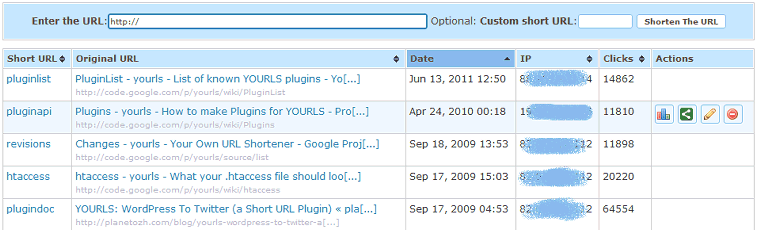
Stats for each short URL


See a live example of YOURLS stats on http://yourls.org/download+